Twitter has long helped businesses build a brand and community. However, the recent turmoil around Elon Musk’s acquisition and the ensuing layoffs and talent flight has prompted some companies to consider alternatives.
Here is a rundown of alternatives to Twitter. This list includes established social networks with features to communicate with followers in a Twitteresque way, as well as apps with global communities, civil debate, less disinformation, and attractive design.
Alternatives to Twitter
Mastodon started in 2016 as an open-source and decentralized project by Eugen Rochko, who was dissatisfied with the state and direction of Twitter. Believing that instant global communications were too crucial for modern society to belong to a single commercial company, he sought to build a user-friendly microblogging product that would not belong to any central authority but remain practical for everyday use. Mastodon is ad-free and chronological. Users post with images, videos, audio, and custom emojis.
Post, founded by former Waze CEO Noam Bardin, seeks to be a civil place to debate ideas, converse freely, and learn from experts, journalists, creators, and each other. The platform aims to organically grow a brand’s audience via a pleasing narrative. Post will allow users to write and share posts, read and comment on content in a clean interface, and buy individual articles from premium news providers and tip creators. The platform hasn’t launched, but you can join the waitlist.
Hive Social is a network to discover info and interact with others. Find new and trending content on the Discover page with subject communities. Post images, text, polls, Q&A, and more. The New Asks feature helps users meet creators. Content in a network is displayed chronologically.
Cohost is a new social media platform with two founders and one employee. Cohost is a blogging site, and posts have no character limit. Users can make multiple pages for projects and collaborative co-owned pages. Cohost features CSS-enabled gamified experiments called “CSS crimes,” which push the envelope of expressive coding. The platform doesn’t use algorithms or promote trends, and it doesn’t sell ads or data.
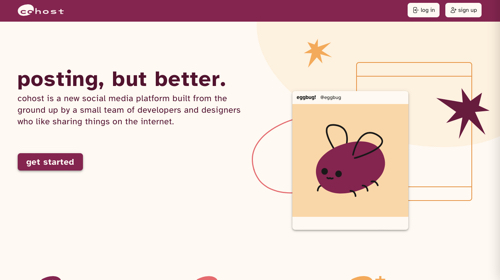
Cohost
Plurk is a free microblogging platform similar to Twitter. Users post “plurks” of less than 360 characters and send private direct messages. Each user’s home page has a timeline that shows the chronology of posts and an optional pinned plurk.
WT.Social, short for WikiTribune Social, is a networking and microblogging platform started in 2019 by Wikipedia co-founder Jimmy Wales. Users post, discover, share, and discuss news items in sub-wikis. WT.Social contains no advertisements and runs on donations. The site aims to be a nontoxic, ad-free alternative to Twitter and Facebook.
Koo is a global microblogging platform with over 50 million users from roughly 100 countries. Koo allows individuals to share views and connect with others in their native language, embracing free speech, mutual respect, and inclusivity. Follow creators, celebrities, or topics. View trending hashtags, upload multiple images, self-verify your account, and apply for eminence. Post messages, polls, videos, and direct messages. Schedule posts, upload multiple photos, talk to type, translate a post, and more.
Comments
Post a Comment